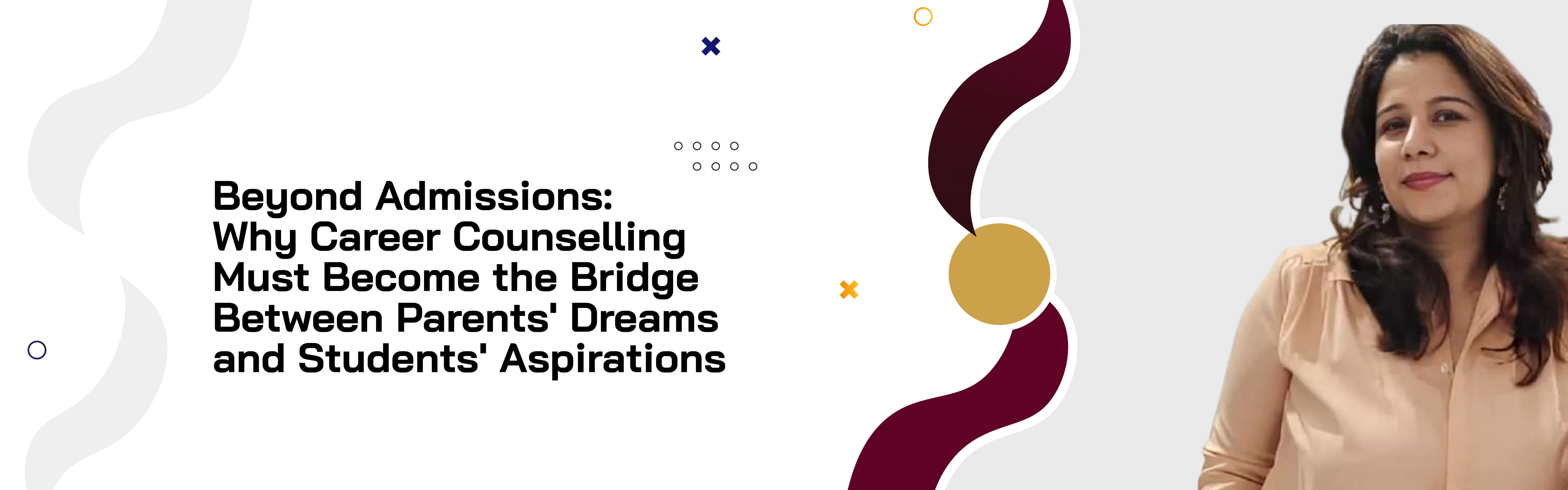
By Sheenu Kathuria
Founder & CEO, EduNation Consultants
"The greatest gift we can give a child is not a career. It is the confidence to discover one."
Every year, millions of Indian students stand at one of the most defining crossroads of their lives. Board examination results are announced, entrance examinations conclude, counselling sessions begin, and families across the country ask the same familiar question:
"Which college should my child go to?"
Yet, I often believe this is the wrong question.
The real question should be:
"Who is this child becoming?"
For decades, career counselling in India has largely been viewed as an admission-centric service - a process of matching marks with colleges and courses. While this approach may have served a generation where career options were limited, it is no longer sufficient for today's learners.
The world our children are entering is fundamentally different from the one their parents prepared for.
Artificial Intelligence is redefining industries.
Climate technology is creating entirely new professions.
Creative economies are expanding faster than traditional sectors.
Portfolio careers are replacing lifelong employment. According to the World Economic Forum's Future of Jobs Report 2025, employers increasingly value analytical thinking, resilience, adaptability, creativity, leadership and lifelong learning over routine technical skills alone. Simultaneously, the OECD's Future of Education and Skills 2030 Framework emphasises that education systems must prepare learners not merely for employment but for uncertainty, responsibility and continuous reinvention.
India's National Education Policy (NEP) 2020 echoes this philosophy by encouraging multidisciplinary learning, flexibility, experiential education and informed career choices rather than rigid academic pathways.
Collectively, these developments send us one unmistakable message:
Career counselling can no longer begin with universities. It must begin with understanding the learner.
When parents visit my office, they usually expect discussions around university rankings, scholarships, employability and visa processes.
Those conversations are certainly important. But before discussing destinations, I prefer understanding the traveller.
Who is this student beyond the marksheet?
What excites them?
What problems do they enjoy solving?
How do they learn best?
What kind of environment helps them flourish?
What motivates them when no one is watching?
Only after these questions are answered does the conversation about higher education truly become strengthening. Unfortunately, many students have never been asked these questions.
Instead, they spend years preparing for examinations while receiving very little guidance about discovering themselves.
That is precisely where career counselling must evolve - from academic advising to personal discovery- That is Why EduNation Consultants came into existence.
Perhaps the most delicate responsibility of a career counsellor is not working with students. It is working with families. Parents carry dreams that have often been built over decades.
Some want security. Some want stability. Some wish to protect their children from the struggles they themselves experienced. Their aspirations are usually rooted in love.
Students, however, are growing up in an entirely different world.
They are exposed to emerging careers, global opportunities, entrepreneurship, technology, design, sports management, behavioural sciences, music production, sustainability, aviation, gaming, digital media and hundreds of professions that previous generations never encountered.
Neither perspective is incorrect. The challenge lies in creating dialogue instead of conflict.
The role of a career counsellor is therefore not to choose sides. It is to build bridges.
Several years ago, a family approached me seeking guidance for their son's undergraduate studies abroad.
The student had completed Grade XII with Physics, Chemistry and Mathematics. His father, a successful businessman in the construction industry, already had a well-defined plan. His son would pursue Business Management in the United Kingdom, return to India and eventually lead the family enterprise. Throughout our first meeting, the father spoke confidently. The mother remained mostly silent. The student barely spoke at all. His silence stayed with me long after the meeting ended. Instead of recommending universities immediately, I requested an opportunity to meet him separately.
Away from expectations, he slowly began to speak. His dream had never been business - It was music.
He had completed all eight grades in guitar, spent years practising, and wanted to pursue Sound Engineering and Music Production professionally. He confessed something that many students quietly carry within themselves.
"If I study business because everyone wants me to, I don't think I'll ever enjoy what I do."
Rather than treating this as a disagreement, I saw it as a design challenge. Over the next two days, I researched interdisciplinary programmes across the United Kingdom.
When the family returned, I presented an academic pathway that combined Sound Engineering with Management, while allowing him to pursue Instrumental Music alongside his degree.
I explained to his father that this was not abandoning business. It was future-proofing his son's education. If he eventually joined the family enterprise, his management education would remain valuable. If he chose music professionally, he would possess internationally recognised qualifications in his chosen field.
Gradually, resistance transformed into understanding. The mother smiled. The father reflected.
The student finally looked hopeful. Nearly two years later, I unexpectedly met his parents.
When I asked how he was doing, his father smiled proudly.
"Ma'am, he performs at concerts across his university and the city. He is becoming a star. We don't want him to come back and join the business yet. He should live his life."
That conversation remains one of the defining moments of my career.
Not because we secured admission into a prestigious university.
But because a family discovered that dreams need not compete with each other.
Sometimes they simply need to be redesigned.
Another misconception surrounding higher education is that profile building exists only to strengthen university applications.
I respectfully disagree. Profile building is not about impressing admission committees.
It is about exposing students to experiences that help them discover themselves.
At EduNation Consultants, profile building forms an integral part of our counselling philosophy because value-driven experiences often reveal strengths that classroom assessments cannot. Our guidance focuses on aligning academic choices with individual interests, aspirations and long-term career goals rather than relying solely on examination scores.
Each experience contributes to something far more valuable than a university application. It contributes to self-awareness.
Universities worldwide increasingly evaluate applicants holistically because they understand that future leaders cannot be identified through examination marks alone. More importantly, these experiences allow students to answer a far more important question:
"What kind of work gives me purpose?"
In recent years, I have also observed a growing tendency to portray parents as barriers to student aspirations. I believe this narrative is unfair. Parents are not obstacles. They are stakeholders. Their concerns are genuine. Their investments—financial, emotional and personal—are significant.
The role of a counsellor is not to convince parents that they are wrong.
It is to help them understand possibilities they may never have encountered themselves.
Similarly, students must also appreciate the wisdom, sacrifices and lived experiences that shape parental expectations.
The most sustainable career decisions emerge not from confrontation but from conversation.
At EduNation Consultants, we have consciously moved beyond being an organisation that simply processes university applications. Our vision has been to create a student-centred ecosystem where personalised guidance, profile building and long-term career planning take precedence over transactional admissions. This philosophy reflects the very purpose on which the organisation was founded—to provide honest guidance and help every student find the institution that genuinely fits their aspirations.
Success, therefore, cannot simply be measured by the number of admissions secured each year.
It must be measured by something much deeper.
How many students gained clarity?
How many parents found reassurance?
How many young people discovered confidence?
How many families left the counselling room more united than when they entered?
These are the outcomes that truly matter.
The future of career counselling lies at the intersection of psychology, education, labour market intelligence, technology and empathy.
Artificial Intelligence may soon recommend universities more efficiently than humans.
Algorithms may predict admission probabilities with remarkable accuracy.
But no technology can replace a conversation that helps a young person discover who they truly are.
No software can understand the emotions in a parent's silence.
No ranking can measure a student's sense of purpose.
That remains profoundly human.
As educators, counsellors and policymakers, we must move beyond preparing students merely for higher education.
If career counselling can become the bridge between parental dreams and student aspirations, profile building can become the pathway to self-discovery, and education can become the process of helping every learner realise not merely what they can study - but who they have the potential to become.
Perhaps then, our greatest achievement will not be the universities our students enter - It will be the lives they build after they leave them.
Sheenu Kathuria
globalpartners@eletsonline.com
speakers@eletsonline.com

© Copyright 2026 All Rights Reserved by Elets technomedia.